Make a resolution to restore our climate

Make a resolution to restore our climate

-Kye Young, VP of Partnerships and Development

The holiday season is upon us and, with it, a time to reflect on the past year and our hopes for the future. Realizing our hopes for the future — a safe and healthy climate — is only possible with the continued generosity of our community.

In many ways, 2021 mirrored 2020. A global pandemic persists, political differences continue to divide, and communities worldwide are emphatically calling for increased action to reverse the devastating impacts of a changing climate.

Though these and many other issues can feel overwhelming, there is reason for hope. A growing sentiment is that a post-pandemic society must not simply return to normal, but rather we must “build back better” — that is, to look deeply at our collective challenges and to move forward, doing and being better. If there is anything positive that I take from the challenges of recent years, it is that small actions can add up to big changes, and if we commit, we can make those changes, even if they seem lofty and unattainable on the surface.

Here at the Foundation for Climate Restoration, we are surrounded by a growing community building a better world for our children, grandchildren and future generations. For us, it all starts with restoring the climate through education, advocacy and solutions.

Thanks to our generous supporters, we have grown the movement across the board. From launching our Youth Leaders for Climate Restoration program in March, to growing our local chapters community globally, the actions required to restore the climate are being mobilized. We believe that in 2022 we will have a chance to significantly impact policy and broader awareness of the urgent need to remove legacy CO2 from the atmosphere.

Any goals we accomplish will only be achieved through continued engagement by our community. As the year closes, I wanted to share various ways you might consider supporting F4CR.

Support our Year-End Matching Gift Campaign

Thanks to the generosity of an anonymous donor, every contribution you make to F4CR between now and 11:59 pm PT on December 31 will be matched up to $50,000. In other words, every donation will have double the impact. Please consider a donation here. You can even donate in honor of a loved one as a holiday gift.

For those that prefer old-fashioned checks, you can send your contribution to F4CR at:

Foundation for Climate Restoration

℅ Gifts Processing

952 S Springer Rd

Los Altos, CA 94024

CARES Act Tax Deduction Benefit

Through 2021, supporters who itemize when filing their tax returns can benefit from an increase in the deduction limit up to 100% of a donor’s adjusted gross income (AGI) for cash gifts.

Previously, the deduction was capped at 60% of AGI. Therefore, donors who make a gift of cash will be able to deduct more this year.

Additionally, supporters who do not itemize when filing their tax returns, but make a gift to charity, will be allowed to take a special tax deduction up to $300 ($600 for couples filing jointly) to reduce their tax liability. A tax-deductible receipt will be generated when you make a contribution here.

IRA Qualified Charitable Contributions (QCD)

Supporters age 70½ or older may make a gift of any amount, up to $100,000 per individual ($200,000 for couples with individual IRA accounts), from your IRA without paying income tax on the donated amount.

For supporters who have a Required Minimum Distribution, making a gift directly from your IRA to the Foundation for Climate Restoration (EIN 82–3487365) will satisfy that requirement. Note that the QCD can only be made from IRAs — not from company plans.

For those who have personalized checks for their IRA account, contact me at Kye@f4cr.org for specific information to ensure their wishes are met.

Stocks/Appreciated Assets

If you are interested in donating stocks/securities or similar assets that you have owned for more than one year, you are entitled to a charitable income tax deduction based on their current value. You also avoid the capital gains tax that you would have paid if you sold the stock.

Because the value of these assets may have increased significantly over time, your tax savings may be sizable. Again, please contact me at Kye@f4cr.org if you have any questions.

Thank you again for your interest and commitment in restoring the climate. Together, we can build back better and ensure that future generations thrive.

Eco-Anxiety and Hope for the Future

Erica Dodds, Chief Operating Officer, F4CR

Living in a world rocked by climate change is hard. It’s hard because of the increasingly frequent extreme weather events, the burden of explaining our uncertain future to kids, and, for more and more people, the general sense of existential dread and anxiety that seems to constantly loom over us.

Psychologists have even coined a new term to explain this feeling: eco-anxiety.

In 2019, I gave a workshop on climate restoration to a group of a few dozen high school students at the Youth Climate Summit in Silver Springs, MD. In the workshop, I asked the students to take a moment to close their eyes and imagine what their lives might look like in thirty years, given everything they knew about climate change. When they opened their eyes, their faces were grim. I asked one student what she had imagined, and she said, “It just doesn’t seem like I’ll have a future.” The rest of the group agreed.

This sentiment is increasingly common among young people today, but it’s not only the young who are experiencing eco-anxiety. Parents and grandparents agonize about the world that we’re leaving to our children, and those without children worry that their legacies will be dire.

One reason eco-anxiety is so widespread is that a lot of our climate dialogue to date has taken the attitude that we need to scare people into action. If only people understood how bad things were, the thinking goes, they would eagerly make the changes needed to safeguard the world as we know it. Information about climate change has featured images of starving polar bears, wildfires, people wading through flooded neighborhoods, etc. These impacts are real and they are important to understand, but they can feel so overwhelming that any individual action seems insignificant and pointless in response.

In my workshop, I proceeded to teach the students about the goal of climate restoration and a few of the carbon dioxide removal (CDR) solutions that already exist and show incredible promise. I explained that although the situation is scary, it’s not too late to fix it. The challenge now is accelerating the development and implementation of effective CDR solutions while we continue to decarbonize our global economy. It won’t be easy, but it’s certainly not impossible.

Again, I asked the students to close their eyes and imagine their future in thirty years, but this time, taking into account the possibility of climate restoration. The difference was night and day. When they opened their eyes, they looked lighter. A few shared that they imagined camping and traveling with their families. Others said they felt energized and wanted to take action.

It’s important to talk about eco-anxiety because so few people are conscious they’re experiencing it. By spreading awareness, we can help normalize the fear and help people identify ways to take action to help combat it. Learning about the possibility of a brighter future can help change our outlook in the present and can give us more energy to bring that future into being. Similarly, taking action toward a healthy climate — by donating, volunteering, lobbying Congress, or just educating ourselves — can help to lift feelings of despair and hopelessness.

Learning about and working toward climate restoration is one of the most powerful ways to combat eco-anxiety. This new paradigm for our climate provides realistic hope as well as avenues to get involved. The combination of envisioning a brighter future and taking concrete action can make a huge difference for even the most stubborn cases of eco-anxiety. Join the Climate Restoration movement to get started.

This Giving Tuesday, support youth leaders

— Kye Young, VP of Partnerships and Development

The holiday season is a time for reflection. It is a time to connect with our loved ones and ponder how we can contribute to making the world a better place. At the Foundation for Climate Restoration (F4CR), we’re focusing this season on supporting the next generation of climate leaders. We are pursuing ways to increase opportunities for young people to become advocates for a future in which they feel secure.

Specifically on Giving Tuesday, we’re fundraising to support our Youth Leaders for Climate Restoration (YL4CR) program to provide scholarships and internship stipends to outstanding young people around the world. Now is a critical time for action.

From November 6–12, I had the pleasure of representing F4CR at COP26 in Glasgow, along with our CEO Rick Wayman. On the long trek back from Glasgow through London to New York, I had a lot of time to contemplate the climate restoration movement and how our message penetrated the walls of the world’s largest climate conference.

I have two significant takeaways:

First, the idea of restoring the climate by removing significant amounts of legacy carbon from the atmosphere is no longer a radical concept. In conversations with UN member state representatives, investors, multinational corporations, philanthropies, start-ups and academic institutions, I found that they all applaud our work and support our effort to mobilize further action to restore the climate. Beyond hearty support, the US Department of Energy’s Carbon Negative Earthshots Initiative showed tangible evidence of policy support for climate restoration.

Second, the world’s youth are not satisfied with the progress made at COP26. The commitments made by member states are not happening at the urgent pace that global youth advocates are demanding. The message was clear. Business as usual (or nominal tweaks to it) is not nearly good enough.

We have heeded the youth’s call to engage deeper and to ramp up action; early this year, we launched the Youth Leaders 4 Climate Restoration (YL4CR) program. The youth-led train-the-trainer program provides opportunities for participants (ages 13–24) to receive quality climate restoration training, practice speaking on large platforms, and get leadership experience through teaching their peers. In the program’s short existence, we have had over 540 applicants and participants from 36 countries and counting.

While there are no costs associated with participation in the program, we recognize that some highly motivated participants can make bigger and longer-term impacts with the help of a financial award. Our youth leaders are exceptionally diverse, coming from all six inhabited continents and varied educational and socioeconomic backgrounds. They are united by their commitment to our planet’s health.

As program participants prepare themselves for professional careers, many need support in pursuing avenues that will allow them to continue contributing to climate restoration. Whether it is tuition assistance, support while they complete an internship or research project, or funding to launch a community organizing project, F4CR wants to do whatever we can to support them in building careers that ensure humanity thrives.

This is why we are focusing our Giving Tuesday campaign on supporting YL4CR. Giving Tuesday is an annual day of giving that unleashes the power of people and organizations to transform their communities and the world. In a season of consumption, it is a day reserved for supporting charity organizations making a difference.

This year it falls on Tuesday, November 30. Donations to this campaign will provide financial support for awards or internship stipends for our youth program participants in their climate restoration pursuits. Furthermore, every donation we receive will be matched up to $50,000, thanks to the generosity of an anonymous donor. It is a tremendous opportunity and we need your support. Please share this opportunity with your networks. We will be sharing tools and resources to help you get the word out to those in your circles. Know that the world’s youth want a stronger voice in the climate fight and we are providing opportunities for them to leverage their passions to restore the climate.

Please consider supporting our Giving Tuesday initiative in any way you can and help us empower the next generation of climate leaders.

Here’s to our youth.

From COP26 — We need to harness the momentum of CDR to restore our climate

Rick Wayman, CEO, Foundation for Climate Restoration

The official proceedings at COP26 in Glasgow have seen some minor breakthroughs on significant issues such as methane, but as Kumi Naidoo suggested at the Global Carbon Removal Partnership (GCRP) launch, by and large, the negotiations have been the diplomatic equivalent of keeping a rapidly-sinking Titanic afloat by bailing out water one bucket at a time.

While some media and activists focus on reasons for despair — after all, this is the twenty-sixth annual Conference of Parties, with precious little tangible progress to show for it — after my first two days at COP26, I remain confident that we can restore our climate by 2050.

Is this just baseless idealism from the new guy? (I started with F4CR only a few weeks ago — see my first blog post). I don’t think so, and here’s why.

Carbon Dioxide Removal (CDR) has emerged as a significant pathway to restore the climate, unlike in years past. There is noticeable momentum to dealing with legacy carbon in the atmosphere TODAY and the industry’s growth is noticeable. The most significant example perhaps was the launch of the Global Carbon Removal Partnership launched at a side event in the official “Blue Zone” at COP26. F4CR co-founded the Global Carbon Removal Task Force at the World Economic Forum in Davos in 2020, and I am so pleased to see it launch as a standalone entity with an influential multi-stakeholder participation and, I believe, great potential to succeed.

The partnership is led by Dr. Sanjeev Khagram, Dean of the Thunderbird School of Global Management at Arizona State University, and will be co-headquartered in Nairobi and Los Angeles. Both the Kenyan government and the City of Los Angeles have been important proponents of CDR. I am proud to see them setting a strong example for other local and national governments around the world.The private sector is also well-represented in the Partnership, with companies working on innovative technological and nature-based CDR solutions collaborating toward a common goal.

The Bellona Foundation hosted another CDR event in the Blue Zone on Monday.The panelists there posited (and I agree) that there is no time to wait. Solutions must be scaled up now, and improvements can be made along the way where necessary. The sheer scale of legacy CO2 that needs to be removed from the atmosphere demands a scale-up of CDR processes of, in the estimation of Christoph Beuttler, Head of Climate Policy at Climeworks, 60–80% per year at a minimum.

This CDR scale-up can be — and is being — advanced by diverse stakeholder groups. Cities are leading from the local level, demonstrating the viability of CDR and policy solutions that can then be scaled and replicated at the national and international levels. The private sector is raising the bar on climate commitments, pushing past “carbon-neutral by 2050” goals and providing the early-stage capital needed to scale the CDR sector. Microsoft was the first company to pledge to become carbon-negative by 2030, and a growing cadre of major corporations is following suit. Individuals are minimizing their own carbon footprints, demanding responsible climate practices from brands, and calling for more ambitious commitments from their government representatives.

Nations, corporations, and individuals absolutely must do everything in their power to eliminate CO2 emissions, and that remains the central message of this year’s COP. But even if we hit the “net-zero” emissions goal today, we would still experience the astounding effects of climate chaos for decades to come due to the trillion tons of legacy CO2 that remain in the atmosphere. UNFCCC recognizes this reality and a small but increasing number of people are recognizing that there is no reason to delay action.

COP26 will likely wrap up at the end of this week with feeble (and at times misleadingly optimistic) declarations from some governments and lingering concerns about equity and access in the official COP process. I am heartened by the power of youth groups, the private sector, and civil society demanding seats at the table. And the fact that cities, countries, and companies are coming together to address the need for carbon dioxide removal allows me to leave Glasgow on Friday evening feeling confident about the future, though much more work remains to be done!

Propelling the Climate Restoration Movement Forward — Meet F4CR’s New CEO

It was an extraordinary honor to be selected last month as the new CEO of the Foundation for Climate Restoration. Before taking the job, I talked extensively with my 12-year-old daughter Lulu about the organization and what it stands for. She didn’t think twice about endorsing climate restoration; to her, it obviously needs to be done, and with great urgency. What motivates me personally about F4CR’s mission is that, when we are successful, we will have restored the climate to pre-industrial levels of CO2 before the time Lulu is the age I am today.

Before joining F4CR, I spent roughly 15 years working for the elimination of nuclear weapons on the national and international level, so I am comfortable working on seemingly impossible issues at the highest levels.

I was part of the core civil society team at the United Nations that negotiated the Treaty on the Prohibition of Nuclear Weapons in 2017, an achievement for which our campaign received the Nobel Peace Prize that year. Our success in achieving this treaty was the result of short-, medium-, and long-term strategies to engage activists, researchers, frontline communities, governments, and many more stakeholders. At all times, we kept the needs and voices of the victims of nuclear weapons testing and use at the forefront of our work. A specific provision in the treaty that I’m particularly proud of is one which calls on countries to provide assistance to victims of nuclear weapons and to restore the environment of places damaged by nuclear weapons production or use.

From 2014–17, I led the civil society effort to support the Republic of the Marshall Islands in its lawsuits against the nine nuclear-armed nations at the International Court of Justice in The Hague, and separately against the United States in US Federal Court. I built an international coalition of over 100 groups to serve as allies and megaphones in the Marshall Islands’ courageous effort, and I provided logistical and organizational support to the team of pro bono international lawyers arguing the cases in The Hague. Throughout this process, I had the privilege of working side by side with Tony de Brum, who was the Foreign Minister of the Marshall Islands. His unshakeable dedication to both peace and climate action — and his effective pursuit of both goals — continues to fuel my hope for the future.

What I’ve learned from my cumulative experience in changing the norms and laws deeply entrenched in systems is that, more than anything, meaningful results are indeed achievable. But success cannot and will not happen without innovation, leadership, and a people-centered approach. This is why I’m so inspired by F4CR’s thought leadership and partnerships with some of the best thinkers and doers who are actively making change.

I have a great deal of hope that we will succeed in our mission. This is not some kind of pie-in-the-sky hope. This is realistic hope. It is based on the fact that technologies already exist that can help us restore the climate, and more are on their way. The fact that we have people of all ages, from many backgrounds and parts of the world, already stepping up to lead, and who are demanding that government officials follow their initiative, is exciting. In just a few weeks with F4CR, I can see that our movement’s leadership is in very good hands, from youth to scientists to business leaders and so many others.

It is no longer acceptable to ignore the climate crisis or pretend that we’ll just figure it out later. The innovations are here, and the processes are improving every day. We can, must, and will act decisively as individuals and as a society to permanently solve this crisis. I’m privileged to be on this journey with you all.

**

Rick Wayman is CEO of the Foundation for Climate Restoration. You can read his full bio here.

Report from the Third Annual Global Climate Restoration Forum

When the Foundation for Climate Restoration was founded in late 2017, we were committed to restoring the climate by facilitating the development of solutions that can safely and permanently remove huge quantities of CO2 from the atmosphere. However, we quickly realized that there’s no shortage of solutions. While we still need more solutions and all of them require further development and scale-up, the real obstacle was creating the enabling environment needed for those solutions to be implemented and scaled. We recognized that we needed to adapt our theory of change to include a focus on creating this enabling environment — the climate restoration ecosystem.

In order to educate our audience about this new ecosystem and keep them apprised of its advances over time, we launched our annual Climate Restoration Forum.

First Annual Global Climate Restoration Forum: Climate restoration is a critical new pillar of our climate agenda.

First Annual Global Climate Restoration Forum at the United Nations

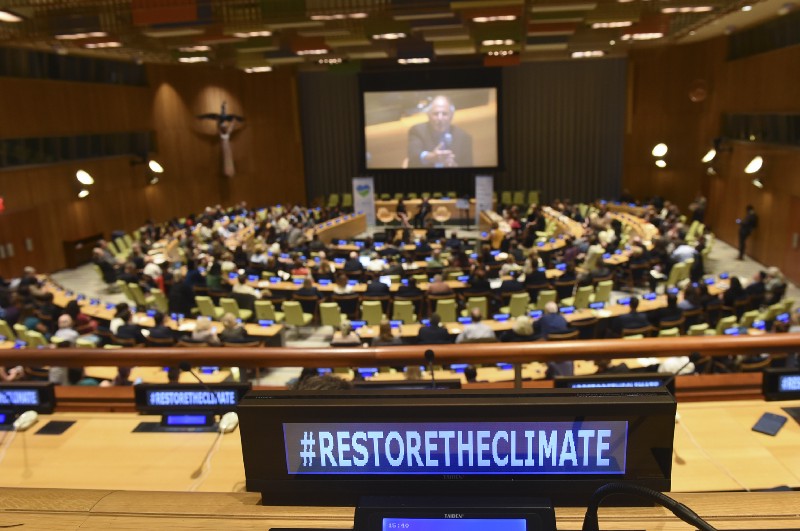
In 2019, F4CR was launched on the global stage through our First Annual Global Climate Restoration Forum, hosted in the Trusteeship Council Chamber at the United Nations Headquarters in New York. In attendance were dignitaries, faith leaders, climate scientists, carbon removal innovators, youth climate activists, investors, and more. The wide-ranging presentations underscored the importance of climate restoration as a new and critical theme in our global climate agenda.

Second Annual Climate Restoration Forum: Climate restoration is becoming widely adopted and is well underway.

In 2020, we continued the conversation virtually with our Second Annual Global Climate Restoration Forum. We brought together panels of experts on science, investment, movement-building, solutions, and more. Over 800 people attended online to learn from the sessions. The Forum highlighted the growing consensus that climate restoration is not only critical, but it’s already underway, with visible progress across sectors.

Third Annual Climate Restoration Forum: Climate restoration is advancing rapidly across sectors.

Just a few short weeks ago, September 30-October 1, 2021, we hosted our Third Annual Global Climate Restoration Forum. As we were planning content for the Forum, we were astonished to see just how much progress had been made since the previous year. It was a challenge to scale back our content and speaker list to a quantity appropriate for a two-day virtual event — and even then, we had fourteen sessions and over 40 speakers! We were thrilled to work with EarthxTV, whose sponsorship of the event elevated our production and distribution quality to a new level. This year’s Forum demonstrated the growing momentum behind the climate restoration movement across sectors.

If you missed this year’s Climate Restoration Forum, don’t worry — all the recordings are available online, and here’s a little teaser.

A few notable quotes from luminary speakers:

“We see these three — climate mitigation, adaptation, and carbon removal / climate restoration — as working in tandem. One doesn’t stop the other, and, on the contrary, they should be mutually reinforcing and sustaining and transformative.” — Sanjeev Khagram, CEO, Director-General & Dean, Thunderbird School of Global Management, Welcome to the 2021 Climate Restoration Forum

“I realized that there’s hope for the future of our earth, where primarily before the conversation around climate action was pessimistic. With climate restoration, we have turned the tables and are being proactive and actually taking action to restore our earth”. — Ashley Meeky, Founder, Youth Leaders 4 Climate Restoration, Youth Lead the Way to Restore Our Climate

“Without withdrawing carbon from the atmosphere, it’s going to be very difficult to reach the targets of net zero. It’s going to be impossible.” — Fredrik Ekström, President, Head of Nasdaq Stockholm, European Fixed Income and ESG, Market Watch: The Growth of the CO2 Removal Marketplace

“It’s no longer a question of if we need carbon removal. Now it’s more of a discussion of which solutions we want to pursue, how we want them to be implemented, where, who we want to be driving these solutions and many other important questions.” — Vanessa Suarez, Senior Policy Advisor, Carbon180, Equity and Justice within Climate Restoration

“Once we become extinct as a species, the oceans will recover. The forest will grow back and so on. So don’t worry about the planet too much. Understand that these climate negotiations are about protecting humanity’s capability to continue to live on this planet. -Kumi Naidoo, Global Ambassador for Africans Rising for Justice, Peace and Dignity, Final Stop on the Road to Glasgow: COP 26

“Removing emissions though is like using a vacuum cleaner on your floor. It is a completely different thing than picking up the dirty dishes or sorting things in the cabinet. It’s a different thing. It is taking CO2 out of the air and oceans after it has already entered them. It is the vector of climate restoration” — Julio Friedmann, Senior Research Scholar, Center on Global Energy Policy at Columbia University, Exploring Legislation to Accelerate Climate Restoration

“I was present when political leaders said to us, please continue to make life difficult for us to remind us of the necessity, to take measures that in the short run may contravene national self interest, but are necessary to preserve the earth. I’ve never forgotten it. This is the tremendous position of people, of faith, all over the world to remind the political leadership and everyone. And of course, ourselves as world citizens, that there is no time to lose.” — Rabbi Soetendorp, President and Founder, Institute for Human Values, Igniting Faith for Climate Action

“The fact that climate is changing, isn’t the end of the conversation, it’s the beginning of, okay, so what do we do about it? This is a solvable problem. It’s not snap our fingers and you know, it all gets done in six weeks. It’s going to take a ton of work all over the place, that’s obvious, but it’s actionable. We can do it. Climate restoration is a key part of it in addition to adaptation and mitigation, reducing emissions as quickly as we can doing it equitably.” — Marcius Extavour, VP, Energy & Climate, XPRIZE, Incentivizing Innovation in Carbon Removal

How can I personally contribute to climate restoration?

For most people, learning about climate restoration follows a pathway that looks something like this:

  1. “Wait…is climate restoration possible?”
  2. “Why isn’t everyone talking about it?”
  3. “So, climate restoration is really just another term for carbon dioxide removal, right?”
  4. “How can I personally contribute?”

This blog post will focus on step four in the journey.

Let’s start off with the bad news, shall we? Just to get it over with.

You, as an individual, can’t fix the problem, and no amount of eco-friendly product swaps will have a meaningful impact on our climate.

But — and this is where it gets good — don’t let that get you down.

Our collective power has always been more impactful than that of any individual. And the problem of climate change is bigger than anything we as humans have ever experienced. It makes sense, then, that the real opportunity to contribute to climate restoration comes from collective action. Here are a few ways you can channel your individual efforts towards effective collective action:

1. Join or start a local chapter

Advocacy is one of the best ways to advance climate restoration. It promotes education about climate change, the importance of climate restoration, and the concrete actions that policymakers can take to restore our climate. Working with a group of similarly motivated individuals towards advocacy goals can also promote a sense of community and optimism that is important for sustaining efforts to restore the climate. Reach out to the Foundation for Climate Restoration team to get connected to a local chapter near you or to start a new one.

2. Learn more about climate restoration, and encourage young people in your life to learn with you

Climate change can be especially scary to young people, who may not know as much about it and whose futures are most at stake due to climate change impacts. This fear can cause eco-anxiety, a chronic fear of environmental doom.

The Foundation for Climate Restoration offers a training program for young people aged 13–24 to learn, speak, and teach their peers about climate restoration, as well as an interactive digital lesson for kids aged 8–12. We’ll also be releasing a Solution Series in early 2022 to delve more deeply into the solutions that can help restore the climate.

3. Donate

The Foundation for Climate Restoration is a 501(c)(3) public charity, which means that all the work we do depends on our community’s support. Without donations, we wouldn’t be able to host local chapters on four continents or support youth leaders on all six. We couldn’t write white papers, or host Forums, or provide a platform for important conversations between climate restoration champions. Please consider supporting the Foundation financially if you, like us, are committed to restoring a safe and healthy climate.

4. Talk to everyone you know about climate restoration

While the concept of restoring the climate has moved much closer to the mainstream in recent years, most people still haven’t heard of it. In fact, most people don’t yet know that the problem of climate change will not be solved when we get to net-zero emissions. The way the climate restoration movement grows is through the conversations carried out by our community. So don’t be afraid to tell your friends / family / neighbors / colleagues / babysitters / mayor, etc. about climate restoration. It makes a difference.

10-5-2021

Scientists, Investors, Government Heads, and Thought Leaders Convene to Discuss Acceleration of the Movement to Restore Our Climate

Forbes

10-4-2021

Erik Kobayashi-Solomon

Bad climate news was front and center in September. The month started with stories of Louisiana heat deaths in the wake of Hurricane Ida and of New Jerseyans drowning in flash floods from the same system a few days later. The month ended with a tornado on the Baltic Sea port of Kiel, in Germany’s northernmost state of Schleswig-Holstein.

Luckily, we had some good news as well in the ClimateTech world, including several announcements about which I am particularly excited! This month, we had news from…

  • Xpansiv
  • Stem, Inc. (STEM)
  • Storegga
  • LanzaTech
  • EnergyVault