Though not an official clinical diagnosis, the American Psychological Association defines eco-anxiety as “a chronic fear of environmental doom.” Eco-anxiety is just as real as any other form of anxiety in that it typically involves the same physical and emotional sensations.
“It’s even more real, in a sense, because the problem triggering the anxiety symptoms is objectively real and massive in scale,” Erica Dodds, chief operating officer of the Foundation for Climate Restoration, told HuffPost. “There used to be more distance between any one person and the world, but now it feels like every problem in the world is right in our living rooms with us.”
Like other forms of anxiety, eco-anxiety can affect anyone, and to varying degrees. “Some people might be proactive in taking measures to protect the planet’s resources, while others might feel so powerless to stop the degradation of the environment they can’t handle thinking about it at all,” Dodds said.
LOS ALTOS, Calif., Sept. 21, 2021 /PRNewswire/ — The Foundation for Climate Restoration (F4CR) today announced its new CEO, Rick Wayman, who will spearhead the global movement to restore our climate and protect the planet for future generations.
Thirty-three years ago, on a sweltering summer day in 1988, NASA scientist James Hansen stood up in front of Congress and testified about an existential threat to the planet: The climate was changing. Heat-trapping gases from fossil fuels were pushing up the global temperature and would lead to more extreme heat and drought in the future. It wasn’t the first warning about the problem, but it helped spur a response. Even George H.W. Bush, campaigning for president at the time, pledged to take on the “greenhouse effect.” The same year, the United Nations launched the Intergovernmental Panel on Climate Change, also known as the IPCC.
A year later, the fossil fuel industry launched an organization to help sow doubt about the problem, funding researchers who were willing to argue that climate science was uncertain, even as internal research at Shell and Exxon detailed the catastrophes that were likely to come from the use of their products. Governments moved slowly to respond, and emissions continued to grow.
What’s all the Hype with Carbon Dioxide Removal? Is It the Same as Climate Restoration?
Carbon dioxide removal has recently received extra buzz thanks to Elon Musk and his $100M competition with XPRIZE to find the best carbon removal technology out there. While the hype is encouraging — anything to drive climate action is paramount — it’s important to understand how carbon dioxide removal stands apart from climate restoration.
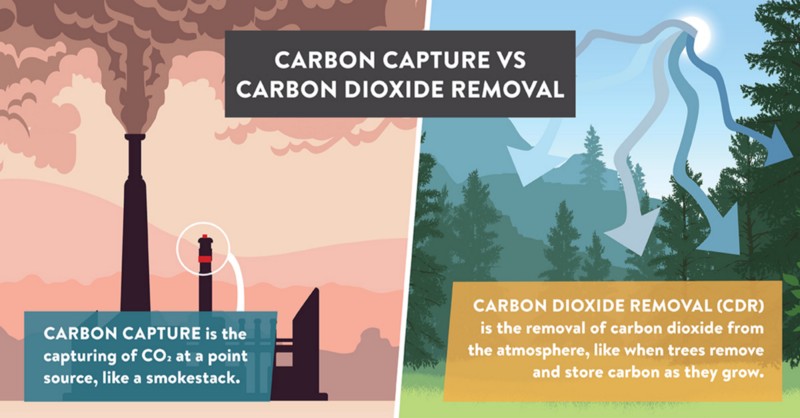
Carbon dioxide removal (CDR) is the removal of carbon dioxide from the atmosphere. This differs from carbon capture, which is capturing CO2 at a point source, like a smokestack. CO2 from both CDR and carbon capture can be used in a multitude of ways, such as synthetic jet fuel and soda. Remember, these terms simply refer to where the CO2 is coming from, not necessarily where it’s going.
Carbon capture is important for a variety of reasons:
It provides more concentrated input streams of CO2 than the atmosphere, making the capture process cheaper and more efficient;
It allows industries with hard-to-avoid emissions to prevent their emissions from reaching the atmosphere;
It helps grow the supply of CO2 that can be used in commercial products, allowing us to build up a market for the CO2 that will be removed from the atmosphere.
Carbon capture processes are a good thing unless they’re taken advantage of, say, by a coal plant with no intention of transitioning to renewable energy, but wants good PR and tax credits from capturing their emissions and burying them underground.
CDR will ultimately allow us to reach net-negative emissions because it doesn’t rely on emissions as a source of CO2. As you may imagine, removing CO2 from the ambient air is significantly harder than pulling it from emissions since it exists in dramatically lower concentrations. Furthermore, there is less CDR infrastructure in place as it’s a newer field.
Graphic differentiating carbon capture from carbon dioxide removal
The goal of climate restoration calls for us to reduce atmospheric concentrations of CO2 to below 300 ppm by 2050. This would require the removal of about 50 billion tons (Gt) of CO2 from the atmosphere per year between 2030 and 2050. Responsible efforts to build up carbon capture and CDR capacity will contribute to building the massive markets and infrastructure needed to achieve this goal.
Here’s the key differentiator between CDR and climate restoration
You could have successful CDR initiatives to convert CO2 into diamonds (shoutout to Aether Diamonds!), use ocean waves for enhanced rock weathering (hey, Project Vesta!), or bury CO2 underground (we see you Carbon Engineering!). However, not all initiatives are created equal, even though they are contributing to building up the technologies and markets needed for climate restoration to succeed.
Climate restoration is a specific and measurable goal and calls for safe and responsible CDR approaches that can meet particular specifications. The 3 pillars of climate restoration are:
Permanence (or, Durability): CDR technologies we deploy must permanently remove the atmospheric CO2 that is warming our planet. This means that net-neutral solutions, like converting CO2 into jet fuel, are not well-suited to climate restoration, even though they contribute to mitigation goals.
Scalability: CDR technologies for climate restoration should reach a scale on the order of tens of gigatons. We need the ability to implement CDR technologies at a massive scale if we’re to remove all historic emissions accumulated from the past century.
Financeability: CDR technologies that fit the climate restoration goal need to have an existing customer. It might be corporations looking to buy carbon removal credits off the voluntary carbon market, or government grants, subsidies, or tax credits. Even better are solutions that convert CO2 into commercial byproducts that serve huge existing markets, like concrete, the second most consumed product in the world, behind water.
As you continue on your climate restoration journey and learn about CDR innovations, it’s important to keep in mind how they fit with these three pillars of climate restoration. Stay tuned as we cover more on the movement to restore the climate.
In these anxious times, there’s a bright spot, though it’s sometimes hard to see: our attitudes about climate change are shifting and converging, including among people of faith. Three quarters of Americans including people of all faiths—white Evangelicals and Black Protestants, Jews, Catholics and people of all other religions—believe climate change is real and is caused by humans.
This is part of an ongoing shift in religious awareness, “a greening of faith,” that has been underway for some time. Christians’ understanding of the Biblical term “dominion” has evolved from our God-given right to dominate and exploit the Earth to our God-given responsibility to care for creation.
Why isn’t everyone talking about climate restoration?
For those new to learning about climate restoration, it can feel like an epiphany.
OF COURSE! Of course global climate goals should focus on the long-term survival and flourishing of humanity and our natural world. Why doesn’t everyone see this? Why isn’t everyone talking about it?
We think there are two key reasons: (1) People assume that if emissions are the root cause of climate change, then stopping emissions will fix the problem, and (2) Activists have seen their calls for emissions reduction dismissed for so long that they’re fed up and see other pathways as a distraction from the needed action.
Reason 1: There’s an implicit assumption that if emissions are the root cause of climate change, then stopping emissions will fix the climate crisis.
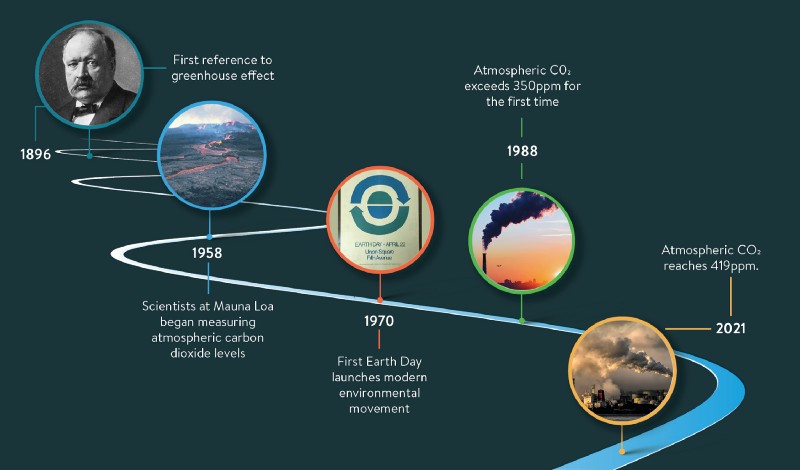
It’s been well over a century since scientists realized that burning fossil fuels causes an enhanced greenhouse effect, warming our planet’s climate. The last half a century has seen scientists and environmentalists begin to rally for reducing greenhouse gas (GHG) emissions. More than three decades have passed since our atmospheric concentration of CO2 exceeded 350 parts per million (ppm), the critical threshold which most scientists consider to be “safe”.
Ever since we crossed the threshold of 350 ppm in 1988, simply reducing emissions was never going to be sufficient to reverse the unsafe levels of atmospheric CO2. There was already too much CO2 in the atmosphere, and changing how much we’re adding wouldn’t fix that. While natural carbon sinks, like forests and oceans, absorb some excess CO2, the majority lingers in the atmosphere for hundreds to thousands of years. An alternative, proactive solution was needed to remove the excess CO2 from the atmosphere.
But that didn’t happen.
Instead, emissions continued to rise, and the cry of “We must reduce emissions!” grew louder. Today, we would be hard-pressed to find someone who didn’t answer that the “solution” to climate change is to reduce emissions. Very few realize, however, that even if all emissions stopped tomorrow, the problem would not be solved.
While it is still critical to reduce emissions, current annual emissions only make up 5% of the problem. Emissions from the last two centuries account for 95% of the excess CO2 causing our climate to change.
Efforts are well underway to reach net-zero emissions, but almost no one is seriously talking about removing the legacy CO2 in the atmosphere yet.
Reason 2: Calls for emissions reduction have been dismissed for so long that activists are fed up.
The urgency to stop the continually rising GHG emissions has largely drowned out calls for other types of climate action. Carbon dioxide removal (CDR) has finally gained attention in the last year, but so far discussions are limited to using CDR to help us reach net-zero emissions rather than looking beyond net-zero and addressing lingering historic emissions.
Of course, CDR without emissions reduction would be futile (think of opening the drain on an overflowing bathtub while the faucet is still on full blast), and it would prolong the life of the extractive and environmentally detrimental fossil fuel industry. But mitigation (emissions reduction) without CDR is also futile. Many long-time climate activists say, “First, we must reach net-zero emissions. Then, we can start dealing with our historic emissions (excess atmospheric CO2).”
We think that these activists are on the right track: CDR cannot be an excuse to continue decades-long tactics of delaying emissions reductions. It’s long past time to act with urgency on our emissions problem. However, we truly believe that we can — and must — do both mitigation and restoration in concert. If we delay building up the CDR capacity needed to restore the climate until after we’ve reached net-zero, it will be too late.
So, why isn’t everyone talking about climate restoration? Because after half a century of calls for emissions reductions have been ignored, climate activists are fed-up with inaction, delay, and distraction tactics. Many believe that reaching net-zero emissions will fix the climate, and most worry that building up the CDR capacity needed for climate restoration will give license to polluters to keep polluting. It’s critical that climate restoration efforts acknowledge and address these critical concerns, and that mitigation and restoration be carried out in concert and with urgency.
Why we’re not waiting for the IPCC to call for climate restoration
If you’ve been reading the news, you probably heard that, on Monday, the Intergovernmental Panel on Climate Change (IPCC) released the first installment of the IPCC’s Sixth Assessment Report (AR6), Climate Change 2021: the Physical Science Basis. If you’ve read the report and accompanying coverage, you may have noticed the absence of any mention of climate restoration.
The IPCC report outlines the rapidly intensifying impacts of climate change and makes clear that prior goals and timelines for mitigating climate change have long since passed. It implicitly underscores the importance of climate restoration: although sustained reductions of CO2 emissions and other greenhouse gases can slow climate change, we can still expect global warming of 1.5°C — or even 2°C — by the end of this century.
While these dire predictions support the importance of climate restoration, the report does not mention it, and folks have been asking us why this is.
Truthfully, we at the Foundation for Climate Restoration (F4CR) aren’t holding our breath. That’s not for lack of faith in the IPCC; in fact, we see the work of the IPCC as critical for aligning and bringing the global community up to speed on the most advanced science around climate change. However, there are two main reasons that we don’t expect the IPCC to take up the call for climate restoration anytime soon: 1) the IPCC focuses on science, not policy, and 2) the IPCC relies on existing scientific research to back up its reports.
Changing by Alisa Singer
1) The IPCC focuses on science, not policy.
The IPCC serves as a global scientific authority on climate change modeling and prediction. According to the Science Council, science can be defined as, “the pursuit and application of knowledge and understanding of the natural and social world following a systematic methodology based on evidence.” Note that this and other definitions point to knowledge and understanding, not to determining how to respond to the phenomena being studied. The IPCC’s role is not to tell governments what to do. Fundamentally, climate restoration is a political and engineering goal, so it isn’t within the purview of a scientific body to promote it.
2) The IPCC relies on existing scientific research to back up its reports.
Another reason that the IPCC is unlikely to take on climate restoration anytime soon is that the body does not conduct its own scientific research. Rather, its reports are built on comprehensive reviews of state-of-the-art research from around the world. As of this writing, there is hardly any scientific literature about climate restoration, so the IPCC would be hard-pressed to find enough data to build a robust report.
Why isn’t there more scientific research about climate restoration?
Again, there isn’t extensive scientific research about climate restoration because it is a policy and engineering goal. One might use science to develop a model of what it would look like to restore the climate (indeed, some have begun to develop these models already), but restoring the climate requires a blend of engineering (“What would it take to get to point x given y parameters?”) and policy to be fully realized.
It’s time for more ambitious policy goals.
As this IPCC report emphasizes, policy has historically done too little too slowly, and climate models have failed to predict just how devastating the impacts of climate change have actually been. In light of this, we shouldn’t wait on scientists to refine their models and lose us precious time to act. It’s time to implement more ambitious goals now.
It is the responsibility of citizens and legislators — and each inhabitant of this planet — to advocate for the implementation of policies that reflect the outcome we want and not the future that is currently predicted. While science can model and predict what the future will look like on various trajectories, only policy can shift our global trajectory and put us on a better path.
We at F4CR recognize that climate restoration is the paradigm shift required to reverse the devastating effects of climate change and protect our planet for future generations.
Even if we fall short of the goal — as we historically have — we will be in far better shape than our current path would predict.
Is Climate Restoration Possible?
The question we hear more than any other about climate restoration is, “Is it possible?”
It’s a good question, and we’re not going to answer it directly here because we’re not oracles. Instead, we’d like to dig into what’s behind this question and why we think we should be asking something else entirely.
We understand why people ask if climate restoration is possible. If you were to tell us that we could have something truly unpredictable, like $10 million in our bank account next week, we would ask the same question. And until we were assured that such a thing really was possible, and there were credible sources to back it up, we wouldn’t get our hopes up. Hope is a delicate, cautious thing for most of us.
So, hearing that there is an organization working toward a future that seems unpredictably rosy — a restored climate — it’s only natural that people are cautious and hesitant to buy in.
The thing to remember about climate restoration, though, is that it’s a goal. According to positivepsychology.com, “Setting goals helps trigger new behaviors, helps guide your focus and helps you sustain that momentum in life.” The purpose of the goal of climate restoration is to guide our collective efforts toward an outcome that would be beneficial to everyone.
Returning to the earlier example, let’s say that someone said their goal was to bring in $10 million next week. There would be a lot of questions: What’s your strategy? Do you have a history of raising that much capital? Do you have prospects already? If not, where are you going to find them? What happens if you don’t meet the one-week timeframe? Framing the $10 million as a goal makes the question of possibility irrelevant — the question becomes how.
The same goes for climate restoration. The key question is: What would it take to restore the climate?
Relevant follow-up questions might be:
Who else is working on this? [A growing cadre of scientists, innovators, investors, policymakers, and citizens.]
Why do the naysayers say it’s impossible? [Climate science is a predictive, descriptive science. We haven’t taken this engineering approach before where we set the goal we want and then look at what it would take to get there. Also, we don’t yet have enough viable solutions ready to scale but more are being developed all the time.]
How would the climate action sector need to shift to bring about a restored climate? [The transition to a net-zero economy would need to accelerate, and the infrastructure for carbon dioxide removal (CDR) would simultaneously need to be massively scaled.]
How much funding is needed, and where might it come from? [It’s hard to say, but depending on the types of solutions that do the heavy lifting, it could take mostly private investment in solutions that will be commercially viable once implemented.]
Humans are masters at bringing about unpredictable futures. Just look at space travel, the pyramids, the Nazca Lines, and so on. In each case, if you had asked beforehand, most people would have told you that these accomplishments were impossible. The proper tools didn’t exist. No one had done anything like it before. There was no evidence that it could be done.
Impossibility is no match for ambitious goals and boundless human innovation.
So let’s do something wild and unpredictable. Let’s restore our climate.